Let's continue our descent into the beautiful, bizarre circus of Argentine football—because the star players got the glory, but the supporting cast provided the sheer, unfiltered lunacy that made those dressing rooms feel less like athletic facilities and more like mobile psychiatric units.
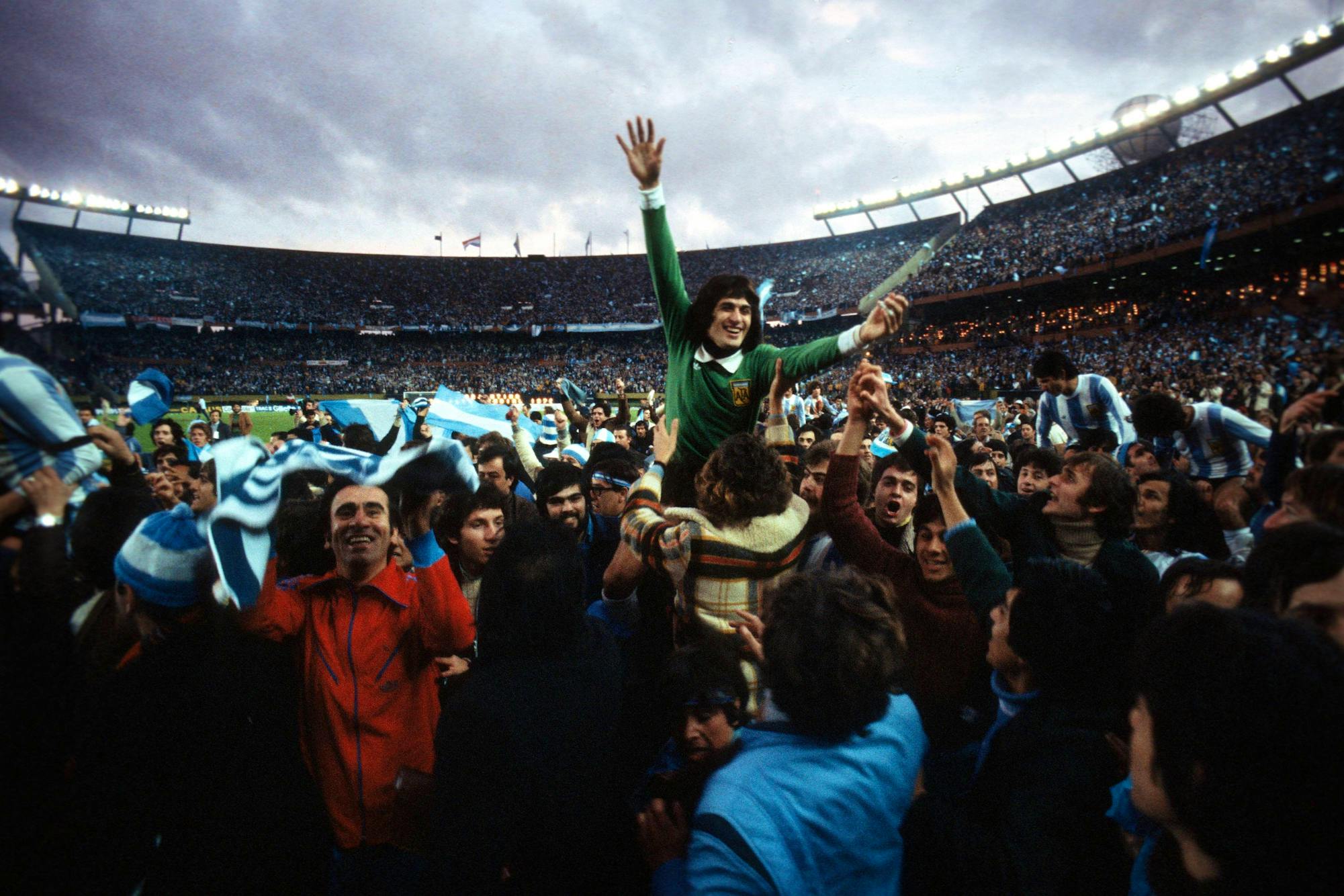
Let us start in the 1970s with Ubaldo Fillol, our goalkeeper. If you closed your eyes, you'd think he was a medieval knight—stoic, imposing, draped in heavy leather gloves that looked like they were stitched together by a medieval blacksmith. But Fillol had a peculiar pre-match ritual that drove me to the brink of sanity. Before the whistle, he would walk up to the goalposts and *talk* to them. I am not joking. He would pat the wood, murmur something under his breath, and glare at the crossbar like it owed him rent. Opposing strikers were so baffled by the sight of a man having a hushed conversation with the goal frame that they often forgot to shoot. He was a genius, but he was also a goalkeeper who believed the woodwork had a personality. I chose never to question it; you don't mess with a man who prays to inanimate objects and stops Pelé for fun.
Then there was Daniel Passarella, the dictator of the backline. The man captained the team with the brutal, unyielding energy of a military junta leader who had somehow obtained a FIFA license. He had a strict rule: no facial hair, no exceptions. In 1978, he walked up to Mario Kempes before a training session and lectured him for ten minutes about trimming his mustache. Kempes, the wild tiger of the forward line, looked at him with the silent fury of a man who hadn't slept in three days, shrugged, and said, "Get out of my face, *capitán*." I was standing between them, ready to stage a diplomatic intervention, but Passarella just narrowed his eyes, grabbed a razor from his kit bag, and said, "If you don't shave it, I will do it myself while you sleep." The tension in that locker room could have pickled a cucumber. We won the World Cup, but half our success was simply due to the sheer fear of getting on Passarella's bad side—a terrifying place where the penalty for a bad back-pass was a stern lecture in the middle of a hotel lobby.
Fast forward to 1986, and we met José Luis "Tata" Brown. He didn't wear boots; he wore *weapons*. Tata looked less like a professional footballer and more like a cargo-ship pirate who had been forcibly re-trained to play center-back. He wore a white bandana around his head that hadn't been washed since the Falklands War, and he launched into tackles like he was trying to break the opponent's femur as a hobby. I vividly remember the final against West Germany. He rose like a gladiator to head that ball into the net, and when he landed, he didn't smile, didn't yell, didn't pump his fists. He just stood up, adjusted his bandana, and walked back to his defensive position with the grim satisfaction of a man who had just chopped down a tree. He was the ultimate enforcer; he didn't care about the game, he cared about the *violence of the game*. He was our mascot, our protector, and secretly, my favorite teammate because he never once asked me to explain a tactical maneuver—he just grunted, and I knew to clear the ball to the left.
Now, let’s jump through the time vortex to 2022, where the "weirdos" have traded the grime for high-tech compression gear, but the madness remains. The modern "normal guy" was Rodrigo De Paul. He was the workhorse, the "go-fer," the man who ran so much that NASA could have used his GPS data to map lunar craters. He wasn't there to play beautiful football; he was there to be the physical embodiment of a pitbull guarding a bone. Every time I cleared a ball, De Paul would appear at my shoulder, gasping, sweating, and looking at me like I had just stolen his last ration of *mate*. He ran 12 kilometers a game while looking like he was personally offended by the opponent's existence.
And finally, the absolute cherry on top of the modern Argentine cake: Emiliano "Dibu" Martínez. He is the village madman placed in the goal. You have not felt true, existential dread until you are standing on your own six-yard box, attempting to mark an opponent, while your goalkeeper does a pelvic thrust facing the opponent's fans during a penalty shootout. I swear, during that final against France, Dibu was doing a full-blown Broadway performance on the goal line, taunting Kingsley Coman like he was heckling a street performer. I watched him from the edge of the box and realized, "We are winning this tournament not because of tactics, but because our goalie is a deranged performance artist who has weaponized humiliation." It worked. He saved the penalty, and I ran up to him, fully prepared to tell him he needed a psychiatrist, but instead I just hugged him because when the crazy works, you don't fix it.
So there you have it. From talking goalposts to dictatorship captains, from pirate bandanas to pelvic-thrusting psychopaths, my career has been an anthropological study of men who are one degree removed from institutionalization. I am the boring, aged defender who just stands there, clears the ball, and watches the circus perform its miracles. I promise you, next week, I will break the *Olarticoochea and the rock* story. But for now, I leave you with this: if you ever see a tall, grey-haired Argentine running slowly toward the center circle, eyes scanning for a madman in goal, wave to me. I'm just trying to survive the show.